Lighting plays a critical role in early broiler development. As more farms upgrade their poultry lighting systems to improve uniformity, welfare, and production efficiency, understanding how light–dark schedules affect chick physiology has become increasingly important. This article reviews new findings on darkness periods and how they relate to modern broiler lighting solutions used in commercial houses.
For many years, the mainstream belief in broiler production has been that providing continuous light (23–24 hours) during the first week helps chicks eat more and grow faster. However, recent research from the University of Georgia presents a different perspective—one that is highly relevant for farms optimizing their lighting environment.
Continuous Light: Why It Became the Tradition
Producers often provide 23–24 hours of light during the first seven days because of two long-held assumptions:
- Continuous light keeps chicks active, ensuring maximum feed intake.
- Constant lighting prevents early starvation-related mortality.
While these beliefs shaped decades of practice, they were never supported by strong scientific data. The new research challenges this traditional mindset.
What the Study Found
A team led by Dr. Garret Ashabranner, Dr. Brian Fairchild, and engineer Michael Czarick conducted multiple trials to evaluate how different light–dark cycles influence broiler chick growth, physiology, and health. Their findings are highly valuable for any farm planning to upgrade its poultry lighting system or improve early brooding management.
The researchers ran six production trials across commercial broiler houses, comparing continuous light with 4-hour and 6-hour darkness periods starting from placement.
Slightly Lower Weight in Week
Chicks receiving darkness showed a small reduction in body weight during the first week. This is expected—because birds with darkness simply rest more.
Strong Compensatory Growth After Day 10
By day 10–21, birds with a darkness period displayed faster growth than those under continuous light.
At key production checkpoints, these birds were:
- Heavier
- Growing more efficiently
- More balanced in daily activity/rest cycles
Feed Conversion and Final Results Not Affected
Despite different light schedules, FCR and final performance were the same or better for birds with darkness. This means the early weight dip does not translate into poorer results at market age.
Improved Leg Health
Some trials showed a reduction in leg problems (lameness), likely due to better rest and reduced early stress.
Higher Melatonin Levels
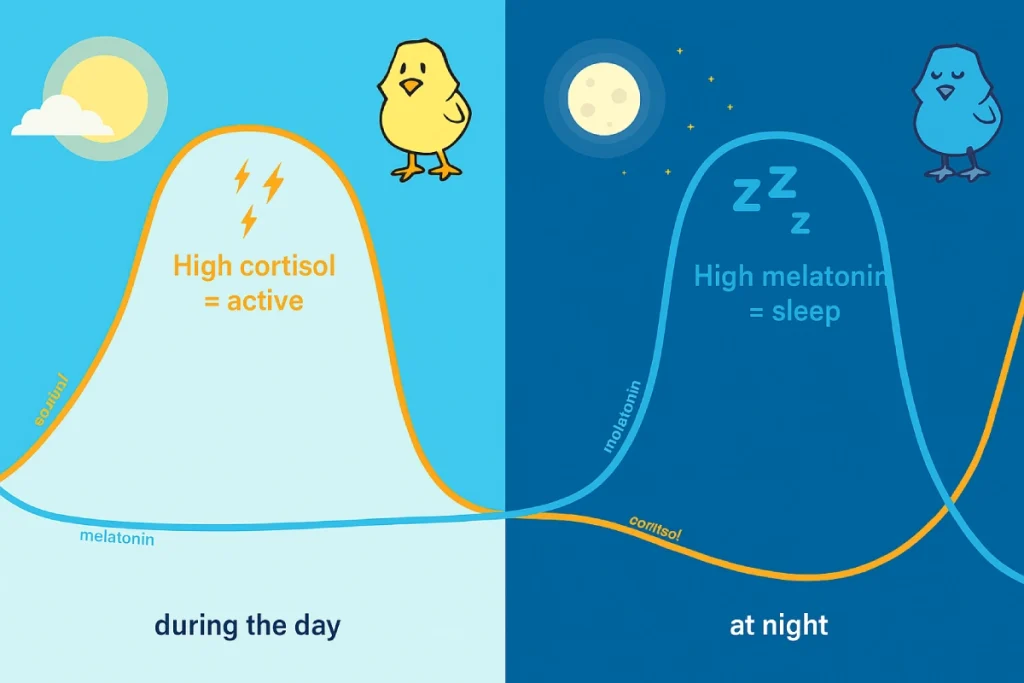
One of the most interesting findings: birds exposed to darkness had significantly higher melatonin “set points.”
- High melatonin = proper rest and recovery
- High cortisol = over-activity and stress
A healthier melatonin rhythm may influence growth, immune response, and overall welfare. This is the first time melatonin was shown to be directly influenced by early brooding light schedules.
What This Means for Broiler Producers
The overall conclusion is clear:
- Darkness from day one does not harm broiler performance
- Continuous light does not provide a performance advantage
- Short darkness periods may improve welfare, bone strength, and long-term growth balance
As Dr. Fairchild summarized: “Providing dark periods from placement gives us valuable insight into how lighting schedules affect broiler performance and physiology.”
Why Lighting Equipment Matters
The study highlights that lighting is more than brightness—it directly influences bird activity, stress level, and biological rhythms. A high-quality poultry lighting system should offer:
- Smooth dimming transitions (sunrise–sunset effect)
- Stable output at low brightness levels
- True flicker-free performance
- Corrosion-resistant and waterproof design
- Compatibility with environmental controllers (0–10V /PLC systems and RS485 communication)
Our constant-power DC poultry bulbs, AC flicker-free bulbs, and smart dimming controllers are designed to maintain uniform brightness and deliver consistent lighting conditions throughout brooding and grow-out.
Conclusion
Introducing a dark period from the first day is not only safe—it may be beneficial for broiler chick development. As poultry farming shifts toward data-driven management and welfare-focused production, optimizing the lighting program becomes an essential step.
For farms looking to upgrade their lighting, explore our poultry lighting products, request a free house lighting plan, or our latest catalog to get started.