
Table of Contents
ToggleWhy Poultry Lighting Matters
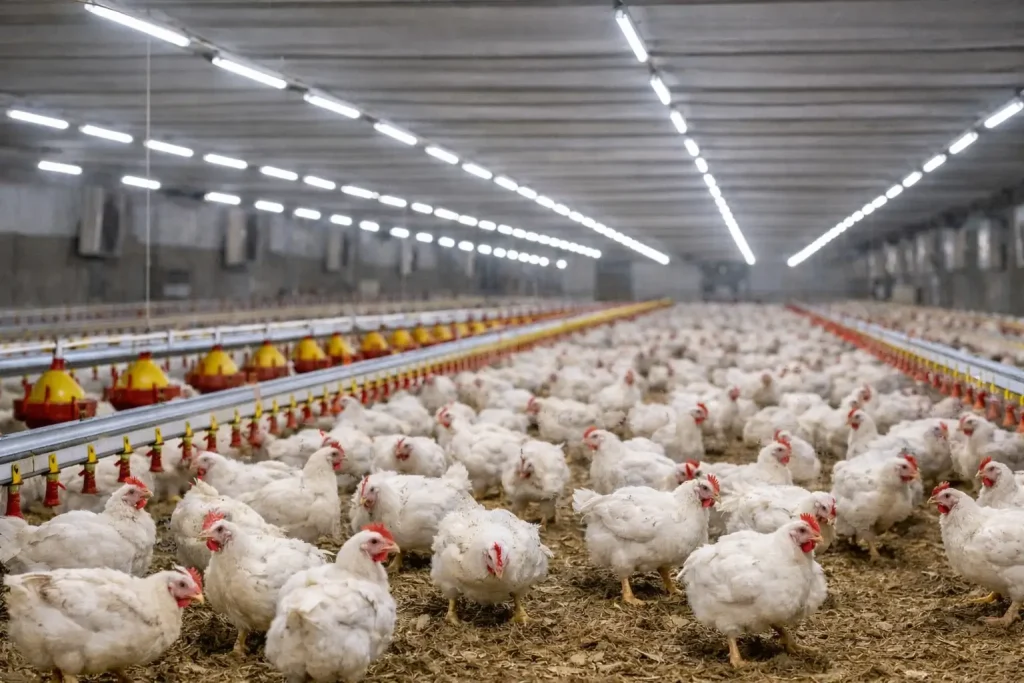
Modern poultry farms are paying more attention to lighting than ever before.
Light is not only used to illuminate the house. It directly affects bird behavior, feed conversion, growth rate, egg production, and overall flock performance.
Choosing the right lighting system has become an important decision for poultry farm owners and equipment suppliers.
What Is AC Poultry Lighting?
AC poultry lighting uses standard alternating current power (110V, 220V, or 240V) to drive LED lamps.
It is currently the most common lighting solution used in poultry farms worldwide.
Advantages of AC Lighting
- Simple installation
- Lower initial investment
- Easy replacement of existing lamps
- Compatible with many farm dimmers
- Suitable for retrofit projects
Limitations of AC Lighting
- Possible flicker under poor dimming systems
- Voltage drop in long poultry houses
- Uneven brightness in long cable runs
- Lower precision at ultra-low dimming levels
What Is DC Poultry Lighting?
DC poultry lighting uses low-voltage DC power (typically 48V system) with centralized power supply and control.
It is widely used in modern intelligent poultry farms.
Advantages of DC Lighting
- Stable and flicker-free output
- Precise dimming performance
- Better uniformity across long houses
- Higher system efficiency
- Easier integration with smart farm control systems
The Challenge of Long Poultry Houses
n long broiler or layer houses, one of the biggest problems is voltage drop.
This leads to:
- Front lamps brighter than rear lamps
- Uneven light distribution
- Inconsistent bird behavior
- Reduced production efficiency
Many farms try to solve this by:
- Increasing cable size
- Adding more power supply points
- Reinforcing electrical infrastructure
But these methods increase installation cost significantly.
Advanced Solution – Constant Power DC Technology
Modern DC poultry lighting systems can integrate constant power control technology.
Key Benefits
- Stable brightness from first lamp to last lamp
- No visible voltage drop effect
- Improved light uniformity in long houses
- Reduced wiring complexity
- Better animal welfare conditions
This is especially suitable for broiler houses longer than 100 meters.
AC vs DC Poultry Lighting Comparison
| Feature | AC System | DC System |
|---|---|---|
| Installation | Easier | More advanced |
| Initial Cost | Lower | Higher |
| Dimming Accuracy | Medium | High |
| Flicker Control | Depends on driver | Very stable |
| Long-distance Performance | Weak | Strong |
| Smart Control Integration | Limited | Excellent |
Which System Should You Choose?
Choose AC Lighting if:
- You are upgrading an existing farm
- Budget is limited
- Lighting lines are relatively short
- Simple dimming is sufficient
Choose DC Lighting if:
- You are building a new poultry farm
- You need precise dimming control
- House length is long (>100m)
- Smart farm integration is required
- Lighting uniformity is critical
Related Solutions from Galaxy Lighting
If you are designing or upgrading a poultry lighting system, we also provide:
- Poultry Lighting Products
- DC 48V Poultry Lighting System
- Dimmable LED Poultry Lamps
- Lighting Layout & Dialux Design Service
Conclusion
There is no universal solution for all poultry farms.
Both AC and DC lighting systems have their own advantages.
The key is selecting the right system based on:
- Farm size
- Installation condition
- Control requirements
- Long-term operation goals
A properly designed lighting system will significantly improve productivity, animal welfare, and operational efficiency.

